
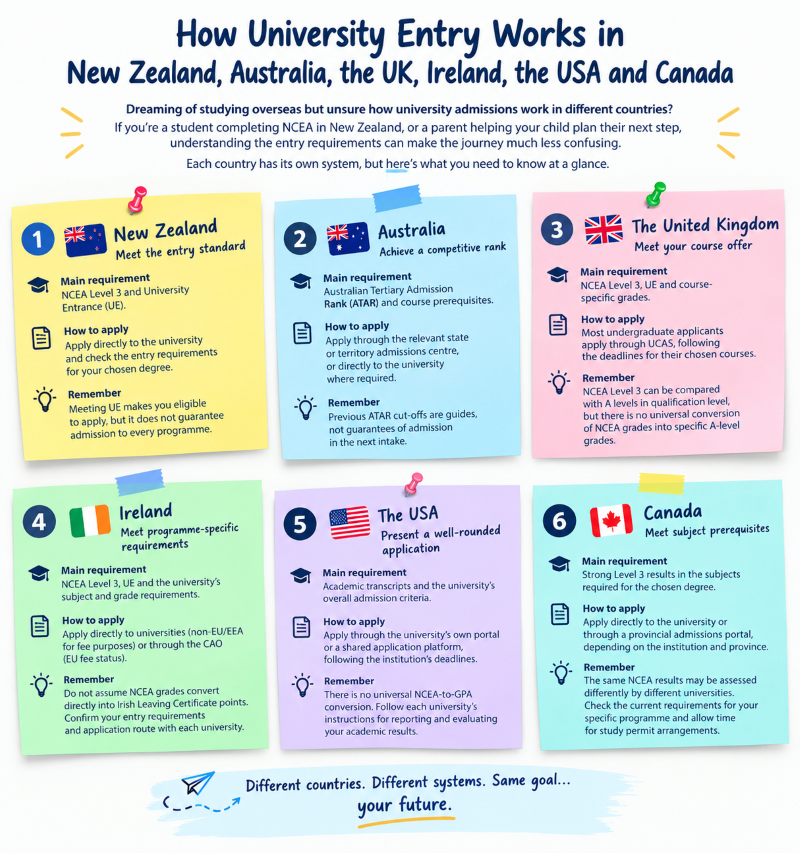
Planning to study overseas? Understanding how universities assess students can make all the difference.
Choosing a university abroad involves more than selecting a country or a course. Each destination has its own admission system, academic requirements and application process. For students completing NCEA Level 3 in New Zealand, understanding these differences early can help them make informed decisions and avoid costly mistakes.
Let’s explore how university entry works in six popular study destinations.
- New Zealand: Meet the standard, then check your course
New Zealand universities use University Entrance (UE) as the minimum academic requirement for school-leaver entry. Students generally need NCEA Level 3, the required credits in approved subjects, and the specified literacy and numeracy credits.
However, meeting UE does not guarantee admission to every degree. Courses such as Engineering may require strong Mathematics and Physics results, while Medicine often involves a separate selection process.
Remember: Meeting the minimum entry requirement is only the first step. Check the specific requirements of your chosen degree.
- Australia: Your ATAR can make a difference
Australia uses the Australian Tertiary Admission Rank (ATAR) to compare applicants for university entry. For eligible NCEA students, NZQA calculates an ATAR using their Level 3 results.
The ATAR ranges from 0.00 to 99.95 and represents a ranking, not a percentage. For example, an ATAR of 85 indicates a ranking above approximately 85% of the relevant age group.
Most applications go through state or territory admission centres, although some courses require direct applications. Universities may also set subject prerequisites and English-language requirements.
Remember: A published ATAR cut-off reflects previous admission outcomes, not a guaranteed offer for the next intake.
- The United Kingdom: Conditional offers and course-specific grades
In the UK, universities set entry requirements for individual courses. Students typically apply through UCAS, often using predicted grades before their final NCEA results are available.
Universities may issue conditional offers specifying the grades and subjects students must achieve. More competitive courses, including Medicine and Engineering, may require strong Merit and Excellence results, particular subjects, admissions tests or interviews.
Although NCEA Level 3 with UE can be compared in qualification level with UK A levels, there is no universal conversion of NCEA grades into specific A-level grades.
Remember: Research the entry requirements for your exact course and university rather than relying on general grade comparisons.
- Ireland: Every programme has its own requirements
Irish universities assess NCEA applicants against their published international entry requirements. Students generally need NCEA Level 3 with UE, along with the subject grades and credits required for their chosen programme.
Application routes depend partly on fee status. Applicants classified as non-EU/EEA for fee purposes can generally apply directly to universities, while applicants with EU fee status typically use the Central Applications Office (CAO).
English-language requirements and additional selection criteria may also apply. Medicine and Veterinary Medicine, for example, can involve further conditions.
Remember: Do not assume NCEA grades convert directly into the Leaving Certificate points system used for Irish school-leaver admissions. Confirm the requirements and application route with each university.
- The USA: Universities look at the whole application
Unlike countries with a common national admission measure, the USA has no single university entrance qualification or national ranking system. Each institution decides how it assesses applicants.
An application may include:
- Academic transcripts and NCEA results
- GPA or an evaluation of international qualifications, where required
- SAT or ACT scores, depending on the university
- Essays or personal statements
- Teacher recommendations
- Evidence of English-language proficiency, where applicable
Universities differ in their testing policies and the importance they give to each component. Application deadlines also vary, with many September-intake applications due between November and January.
Remember: Strong grades matter, but students should prepare a complete application that reflects their academic record, interests and goals. Never assume that NCEA grades convert to a standard GPA formula.
- Canada: Focus on prerequisite subjects
Canada does not have a single national university entrance system. Provinces and territories oversee education, while individual universities establish their own admission requirements.
For NCEA students, admission commonly depends on Level 3 grades in the subjects required for the chosen programme. Engineering, for instance, typically requires Mathematics and relevant sciences. Competitive courses may also request supplementary applications, essays or activity profiles.
Applications may be submitted through provincial portals or directly to universities. English-language evidence and official school transcripts may also be required.
International students must meet the applicable study permit requirements after securing admission.
Remember: Universities can assess the same NCEA results differently. Check each institution’s current international admissions guidance.
Which country is right for you?
The best destination depends on your academic strengths, intended degree, budget and preferred learning environment. Here is a quick comparison:
|
Destination |
Main admission factor |
Typical application route |
|
New Zealand |
UE, subject requirements and sometimes rank score |
University |
|
Australia |
ATAR and course prerequisites |
State admission centre or university |
|
UK |
Course-specific grades and conditional offers |
UCAS |
|
Ireland |
University-specific academic requirements |
Direct application or CAO, depending on fee status |
|
USA |
Holistic review of academic and other application components |
University or shared application platform |
|
Canada |
Grades in required subjects and programme-specific criteria |
Provincial portal or university |
When should students start planning?
Early preparation can prevent last-minute surprises.
- Year 11: Explore career interests and identify the NCEA subjects needed for possible degree pathways.
- Year 12: Shortlist universities, check prerequisites, set academic targets, and investigate scholarships, English requirements and application deadlines.
- Year 13: Prepare applications and transcripts, arrange any required tests, monitor deadlines and ensure final results meet conditional offers.
Students should also consider tuition fees, accommodation, visa or study permit requirements, and eligibility for scholarships based on citizenship or residency.
Final thoughts
Studying overseas can open up exciting opportunities, but there is no single set of rules that guarantees university admission across all six destinations.
The most important step is to work backwards from your chosen degree. Identify the universities you are interested in, check their current entry requirements, confirm the required NCEA subjects and grades, and prepare your application well ahead of the deadline.
A well-planned application gives students a clearer understanding of their options and helps families make more confident decisions about their future.
Note: Admission requirements, application deadlines and visa rules can change. Always confirm the latest information with the university and relevant official admissions authority before applying.
For details, get in touch with an Edvantage counsellor now!